
Pflugerville City Directory Holdings
No standalone, long-running Pflugerville city directory was verified in the Texas State Library holdings list or on the public library pages. That absence changes the method. The best local starting points are the 1957 and 1958 Travis County Rural Directory volumes, then regional Austin directories and address-oriented criss-cross books. A Pflugerville result in a regional volume is useful evidence, but Austin coverage is a proxy, not proof that every Pflugerville household appeared in every edition. Use the collection title and the place label printed in the book rather than applying current city limits to an older entry.
| Collection | Years | Where Held | Access |
|---|---|---|---|
| Travis County Rural Directory | 1957 and 1958 | UNT Portal to Texas History | Digitized page images; check Pflugerville and rural-road sections |
| Austin city directories | 1872-1992, with gaps | Texas State Library and Archives Commission, Austin History Center, and selected Portal volumes | Regional proxy; confirm that the locality is included |
| Austin Criss Cross directories | 1939-2002, with gaps | Texas State Library and Archives Commission and Austin History Center | Address or telephone route to a listed occupant |
| Pflugerville Digital History Project | Dates vary by object | Pflugerville Library ContentDM collection | Online metadata, photographs, documents, and memorabilia |
| Travis County Citizen | Identified Pflugerville title, 1964-65 | UNT Portal to Texas History | Digitized newspaper issues; verify each notice against another record |
The table is a set of routes, not a claim of a complete household list. For records missing online, ask the library reference desk about its current directory, telephone-book, obituary, yearbook, and database holdings; those exact shelf runs were not exposed in the source pages. Austin History Center, the Travis County Archives, and state or university microfilm are the next channels when a scan or local shelf comes up short.
Pflugerville's Regional Directory Strategy
Pflugerville's historical records sit in more than one geography. Travis County sources, Austin reference collections, rural postal labels, and later city material can all describe the same family at different times. Austin directories begin in 1872-73 and have many later runs, while Austin History Center lists selected digitized years through 1922. Its property guide says post-1905 books include address cross-reference material. Start in the address section when an old address is known, then move to the alphabetical name listing to test the match.
For a Williamson County parcel with a Pflugerville mailing label, add Williamson deed books and microfilm routes to the search. The municipal footprint crosses Travis and Williamson County lines, and historical census geography may use a county, precinct, rural route, or community name instead of the current city. A missing name can reflect that changing geography, not a failed search.
Note: Record the county, community label, directory title, and page before comparing an entry with modern maps or property records.
The 1957 Pflugerville Rural Directory
The digitized 1957 Travis County Rural Directory is the clearest verified directory source for the Pflugerville area. Rural Directory Service of Central Texas in Austin published the 110-page volume. It covers farms, rural roads, post offices, town entries, and area names. It is not a modern city-boundary directory, so an entry supports a historical association with the listed route or town label, not a continuous claim about residence.
The scan has page-image searching only as far as its OCR succeeds. Begin with the Pflugerville or PFL town/index pages, then inspect neighboring pages and rural-road entries. The parallel 1958 volume is best used as a comparison point: recurring surnames, road descriptions, and telephone entries can strengthen a trail, while a change can point to a move, a new mailing route, or a different listing practice.
The digitized rural directory shows the kind of page-image access available for Pflugerville city directory research.

Use the image viewer with a page citation, because a spelling correction or OCR match should never replace what the printed page actually says.
Pflugerville Directory Marks and Keys
Small marks carry a lot of meaning in the rural volumes. In the 1957 key, an asterisk marks a home owner. Bx means box, PO means post office, Rt means route, Rd means road, Hy means highway, and FR means farm road. Pflugerville appears as PFL in the post-office key, and EDgewood is the telephone exchange. Photograph or transcribe the key before interpreting an individual listing.
| Name | Printed surname and given name; preserve the form before trying a normalized spelling. |
|---|---|
| Spouse | Wife or spouse information where printed, useful as a separate family clue. |
| Location | House number, road number or name, mailing address, route, box, or post office. |
| Telephone | Listed exchange and number, which can help distinguish similar names. |
| Ownership mark | An asterisk in this directory means home owner, not a special personal category. |
| Page reference | The volume and page needed to audit the reading later. |
- Criss-cross directory
- An address- or telephone-ordered section that can lead from a place to a listed occupant.
- Householder index
- An alphabetical household listing used to locate a name before checking the address context.
- Abbreviation key
- The volume's explanation of its marks and shortened place terms; it should be read before the entry.
A directory's listed work or activity field appears in the 1957 volume, but the safer historical use is the name, spouse, location, telephone, ownership mark, and page. The asterisk is an ownership indicator only. It does not prove possession on every date between two editions.
Pflugerville Directory Companion Sources
Pflugerville Public Library community resources connect genealogy, local history, research databases, and Heritage House Museum. The library's electronic resources also link the Pflugerville Digital History Project, a collaborative collection of photographs, documents, and memorabilia. Search that collection by a name, place, school, church, road, or business, then inspect nearby objects and metadata. Contributor or subject browsing can reveal a series that a simple surname search misses.
The library community-resources page is a useful first stop before asking the reference desk to confirm physical directory or yearbook holdings.

Library, museum, and digital-project evidence adds local context, but it should be paired with a dated directory, census, deed, or tax record when a household connection matters.
The 1936 Travis County rural school yearbook is another verified companion source for Pflugerville and Mandor-area school material. Yearbooks can reconnect former classmates and document organizations or locality during a school year. Federal census schedules released through 1950 provide a separate household snapshot, although their county and precinct labels may not match today's city boundary.
Pflugerville Archive Access Alternatives
When a directory page is missing, move outward through the recorded access channels. The Travis County Archives collections include finding aids and a Preservica digital collection, while in-person research is appointment-based. The archive guide points researchers to the Austin History Center, Pflugerville Public Library, Heritage House Museum, county clerk records, cemetery work, newspapers, census, and family collections. It does not usually hold property surveys, so confirm a collection before expecting a house file.
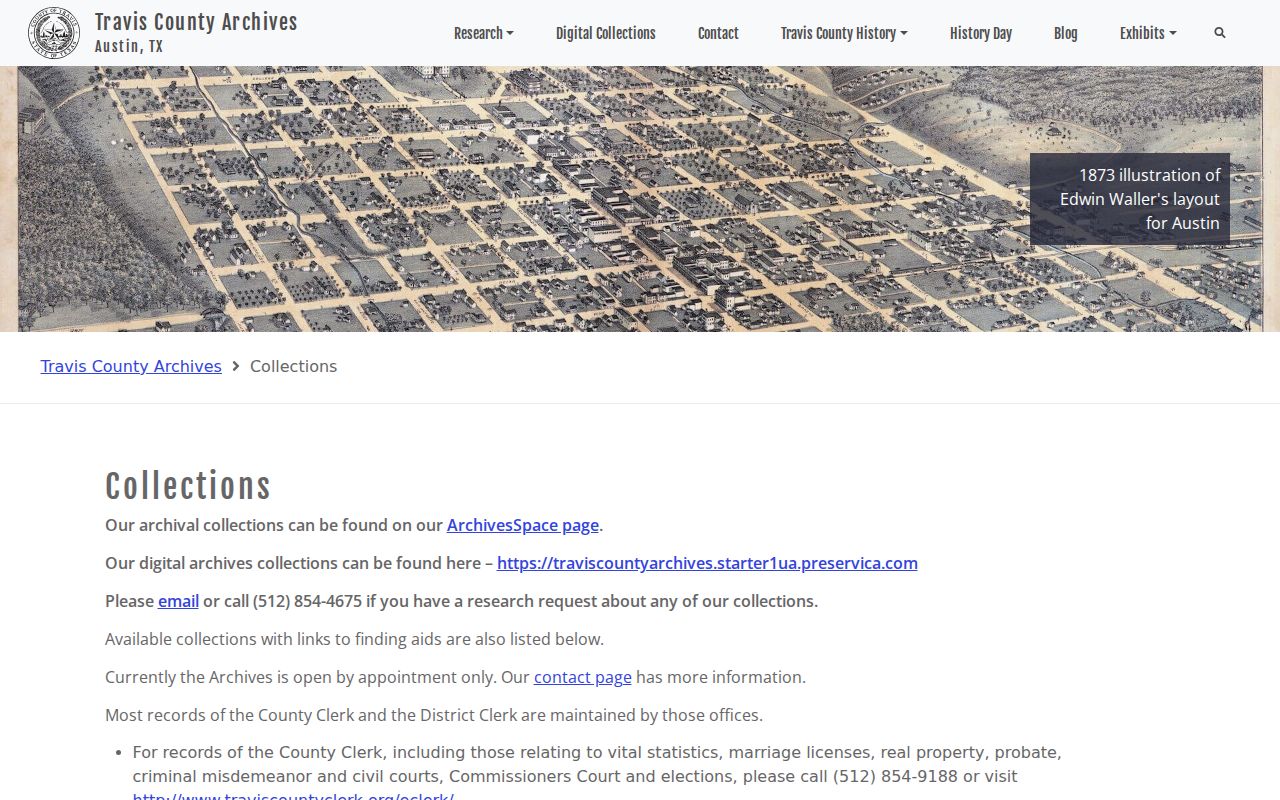
The Travis County Archives holdings page identifies digital and appointment-based paths for older Pflugerville city directory companion research.
For historical land or county books, the archive, county clerk, Portal to Texas History, and microfilm depositories each hold different pieces. Williamson material has separate deed-index and deed-book microfilm routes through Baylor and the Texas State Library guide.
Pflugerville Directory Clues in Print
The digitized Travis County Citizen appears as a Pflugerville newspaper title in 1964-65. Notices can offer dates for marriages, deaths, anniversaries, school events, civic groups, and local addresses. Treat a notice as a dated clue. A county, state, church, cemetery, or family record may confirm the identity behind it.
There is no verified city-run cemetery search for Pflugerville. Cemetery offices, church registers, archive projects, established cemetery indexes, probate files, and obituary material are more appropriate alternatives. A burial place alone does not establish a person's residence, and a directory omission alone does not establish a death or move.
Note: Match a newspaper item by name, date, place, and at least one independent record before attaching it to a family trail.
Pflugerville City Directory Timeline
Directory research becomes clearer when the collection's period is kept beside changes in local custody and geography. These dates mark useful turning points, not a claim that every volume covers every Pflugerville household.
- 1872-73: Austin city-directory holdings begin in the Texas State Library collection.
- 1939: Austin Criss Cross holdings begin, with gaps, giving later researchers an address-to-occupant route.
- 1957: The Travis County Rural Directory documents Pflugerville-area town and rural-road entries.
- 1958: A second rural directory volume supports year-to-year comparison.
- 1965: Pflugerville incorporated in Travis County; later annexations produced the present two-county footprint.
Earlier records may use surveys, roads, rural routes, or community names that predate incorporation. Later county appraisal and GIS systems can help bridge a current address back to a tract, but they do not replace the historic wording in a directory or map.
Tracing Families Through Pflugerville Directories
For family history, start with the best known historical surname, address, road, or community label. A rural entry may use a road, route, box, or post office rather than a modern street. Preserve the exact printed name, spouse notation, address, telephone, ownership mark, and page. Search nearby alphabetical entries and common spelling variants, especially where OCR or older German-origin names could create a false negative.
- Find the first plausible appearance in the Pflugerville, PFL, rural-road, or regional directory section.
- Record the volume, printed form, page, address language, spouse clue, telephone, and ownership mark.
- Compare the next available directory year, allowing for gaps, route changes, and altered telephone exchanges.
- Use a criss-cross section where available to test the address against the listed household name.
- Pair the directory year with the closest released census, deed recording, tax roll, newspaper notice, school yearbook, probate file, or cemetery source.
A person who disappears from a directory may have moved, died, changed a listing, or simply been omitted. A new listing may also be a different person with the same name. Test both possibilities with a dated record from the correct county. For a current address-based chain, the Pflugerville street directory provides the separate modern parcel and deed route.